
The Plot to Murder Jesus
1. And it came to pass when Jesus had finished all these words, He said to His disciples,
2. “You know that after two days is the Passover, and the Son of Man is delivered up to be crucified.”
3. Then gathered the chief priests and the scribes, and the elders of the people, into the courtyard of the chief priest, who was called Caiaphas;
4. And consulted that they might take hold of Jesus by deceit, and kill [Him].
5. But they said, “Not at the festival, lest there be an uproar among the people.”
At this point in the biblical narrative, Jesus has been with His disciples for over three years. All along, He has been patiently instructing them. At times, He has encouraged them with promises about an exalted status when they would be sitting on twelve thrones judging the twelve tribes of Israel (see Matthew 19:28). At other times, He seemed to be giving an opposite message, telling them that those who exalt themselves will be humbled and those who humble themselves will be exalted (see Matthew 23:12).
Eventually, the disciples would come to understand that the work of “ruling’ and “judging” is something that takes place within everyone who uses the Lord’s truth to rule over lower desires and judge between self-serving and noble intentions. In humbly doing so, they would be “exalted.” In other words, they would be lifted up to higher states of love, wisdom, and usefulness. As Jesus said in the previous chapter, “Well done good and faithful servant. You have been faithful over a few things; I will make you a ruler over many things” (Matthew 25:23).
Through parable after parable, and example after example, Jesus has done everything possible to prepare His disciples for His last days on earth and His final departure. The lessons began on the mountaintop when Jesus said, “Blessed are the poor in spirit,” “Blessed are those who mourn,” “Blessed are the meek,” and “Blessed are those who hunger and thirst for righteousness” (Matthew 5:3-6). These initial teachings became the foundational themes of this gospel, culminating twenty-five chapters later when Jesus left the temple and gave three final parables, one about love, one about wisdom, and the last one about useful service.
But it all begins with Jesus’ initial teaching, “Blessed are the poor in spirit, for theirs is the kingdom of heaven” (Matthew 5:3). Similarly, the six acts of charity, when understood spiritually, teach that same lesson. When we hunger for good, thirst for truth, desire to be instructed, and acknowledge that without the Lord’s constant protection we are spiritually naked, spiritually sick, and spiritually imprisoned, we acquire the humility that can receive the kingdom of heaven. 1
Once we make this acknowledgement and strive to put away the evil and falsity that block the Lord’s entrance, the Lord enters with love, wisdom, and power, enabling us to serve others in ways that are truly good. Just as Jesus promises that the poor in spirit will receive the kingdom of heaven (see Matthew 5:1), He promises that those who perform the six acts of charity with God’s love in their hearts and wisdom in their minds will inherit the kingdom prepared for them from the foundation of the world (see Matthew 25:34).
From this point on, Jesus tells no more parables. It’s time to see if the disciples can put Jesus’ teachings into their lives. Similarly, there are times in each of our lives when we have received sufficient instruction. We have learned the truth; the task is now to apply it to life. Therefore, the next episode begins with the words, “When Jesus had completed all these sayings, He said to His disciples, ‘You know that after two days Passover takes place, and the Son of Man will be delivered up to be crucified’” (Matthew 26:1-2).
Even while Jesus is preparing His disciples for His crucifixion and death, the religious leaders are plotting it. As it written, “Then the chief priests, the scribes, and the elders of the people gathered together at the palace of the high priest, who was called Caiaphas. And they plotted how they might take Jesus by deceit and kill Him” (Matthew 26:3-4). 2
This time, it’s not just the Pharisees or the Sadducees. It’s all of the religious leaders together. This includes the chief priests, the scribes, the elders of the people, and even the high priest himself. This represents not just an isolated attack of a few evils within us, but rather an all-out assault on everything we believe to be good and true — including our faith in the Lord Jesus Christ.
It should also be noted that this assault will not be a direct and open one. Rather it will be done in a sly and treacherous manner. As previously quoted, “They plotted how they might take Jesus by deceit and kill him” (Matthew 26:4). Moreover, they know that the murder should not take place during the high holiday called Passover. This is not out of respect for Passover and all that it represents. Instead, it is out of the fear that the murder of Jesus might upset the people who have come to love and admire Him. Therefore, they say to each other, “Let’s not do it at the feast, lest there be an uproar among the people” (Matthew 26:5).
A practical application
This chapter begins with Jesus predicting His capture and crucifixion. As He says, “the Son of Man will be delivered up to be crucified” (Matthew 26:2). This is the fourth time in this gospel that Jesus has predicted His capture, crucifixion, and death (see also Matthew 16:21; Matthew 17:22-23; Matthew 20:17-19). At the same time, Jesus has been continually teaching His disciples about the importance of being prepared. This will be most important when their beloved leader is taken into custody, tortured, and crucified — a dream-shattering experience. There are times when we, too, will undergo difficulties, perhaps dream-shattering ones. How will we face them? When it seems that all the forces of hell have ganged up on us, stripping us of our trust in the Lord, how will we respond? This is what is pictured by the religious leaders who assembled together to plot Jesus’ capture and death. It is an all-out assault on our faith in Jesus as our Lord. If we begin to question Jesus’ divinity, we can know that the plot to murder Jesus has begun. The thought may arise, “He may be a good man who lived many years ago, but he is not divine.” This is the slippery slope that can lead us from doubting the divinity of Jesus to doubting the divinity of His teachings. As a practical application, then, be aware that these are the times when your faith is being tested. Do not succumb to the false thoughts that strive to enter. Instead, remain steadfast in your faith in Jesus, in the divinity of His teachings, and in His power to save. 3
Costly Oil
6. And when Jesus was in Bethany, in the house of Simon the leper,
7. There came unto Him a woman, having an alabaster [vessel] of ointment, very precious, and poured it on His head as He sat.
8. But when His disciples saw [it], they were indignant, saying, “For what [purpose was] this loss?
9. For this ointment might have been sold for much, and given to the poor.”
10. And Jesus knowing, said to them, “Why belabor the woman? For she has worked a good work on Me.
11. For you have the poor always with you; but Me you have not always.
12. For in that she has poured this ointment on My body, she has done [it] for My burial.
13. Amen I say to you, wherever this gospel shall be preached in the whole world, what this [woman] has done shall be spoken for a memorial of her.”
The previous episode provides a general description of how the hells conspire to destroy our faith in the Lord. This is pictured as a convocation of all the religious leaders at the palace of the high priest. Their goal is to capture and kill Jesus, especially by trickery and deceit. In this next episode, we are given a specific illustration of how this takes place. It comes in the form of a suggestion that devotion to the Lord is a waste of time. According to this kind of reasoning, our time and energy could be better spent in helping the poor, not in worshipping Jesus.
The episode begins with a story about a woman who anoints Jesus’ head with very costly, fragrant oil. In biblical times, when a king took office, the official coronation ceremony featured the use of oil in anointing the new king. The first three kings of Israel, Saul, David, and Solomon, were all anointed with oil to symbolize that they were divinely appointed by God.
In fact, the very term, “Messiah” means “anointed,” and was associated with the coming king who would be their new ruler. It was believed that the prophesied Messiah, “the anointed one,” would come to save His people from oppression. As it is written in the Hebrew scriptures, “The Lord has anointed Me … to proclaim liberty to the captives, and the opening of the prison to those who are bound” (Isaiah 61:1).
By anointing Jesus’ head with oil, this woman is not only expressing her love and gratitude for all that Jesus has done for her, but she is also recognizing Jesus as the promised Messiah. The oil of love and gratitude is “very costly” because it has been achieved through the combats of temptation. In every temptation combat that we undergo, it is the Lord who fights for us every step of the way. 4
Therefore, as this woman anoints Jesus’ head with oil, she is representatively acknowledging Him as her king, the anointed one who provides divine truth. This is the truth that not only offers comfort, but also helps us to win the victory in every combat of temptation. The truth that we hold in our minds and use in our lives becomes a divine vessel through which the Lord pours His love. It is this love, working through truth, that gives us the power to refrain from evils of every kind. 5
The deceitful trickster in us, however, sneaks in to take the credit for every victory in temptation. “Nice job,” we hear whispered into our inner ear. “You are very good at overcoming in temptation.” To the extent that we take credit for our part in subduing the hells within us, we discredit what the Lord has done for us. We do not anoint His head with oil. We do not acknowledge Him as the ruler of our lives, and the source of every victory. This is another way that we can be deceived.
Because the Lord allows us to feel that we have won the victory by ourselves, we forget that the credit for every victory belongs to the Lord. Although we must do our part, it is the Lord alone who subdues the hells in us, and it is the Lord alone who wins every victory. If pride takes the place of humility, we will go through further temptations until we realize that the credit belongs entirely to the anointed one, the only king, the Lord alone, and that we deserve nothing. 6
The disciples, however, see it differently. When the woman anoints Jesus’ head with the costly oil, they do not admire her for her devotion to the Lord. In fact, they are indignant. This is understandable. After all, Jesus has just told them a parable about the necessity of feeding the hungry and clothing the naked (see Matthew 25:35-45). Therefore, they say, “Why this waste? This ointment could have been sold at a high price, and the money given to the poor” (Matthew 26:8-9). Jesus, however, who is continuing to instruct them, says, “Why do you trouble the woman? For she has worked a good work upon Me” (Matthew 26:10).
Going deeper
It is true that we should help the poor. After all, Jesus made this quite clear through the literal meaning of the parable of the sheep and the goats. It is, after all a “good work.” But it’s too easy to forget that the Lord must be central in our lives. When this happens, the hells can sneakily convince us that worship is a waste of time, that reading the Word is pointless, and that time spent in prayer could be better used by doing good for others.
But all of this misses the main point of this lesson. And it is simply this: every good work is only good insofar as it is the Lord working through us. In other words, good works are important. In fact, they are the goal. But we can’t reach that goal in a selfless way without first keeping the Lord at the center of our lives. Therefore, keeping the Lord on the throne of our inner life is also a “good work.” It is, in fact, the first and greatest of all good works. As Jesus said earlier in this gospel, “You shall love the Lord your God with all your heart and with all your soul and with all your mind. This is the first and greatest commandment” (Matthew 22:37-38).
In essence, this is what Jesus means when He says, “The poor you have with you always, but you do not always have Me with you” (Matthew 26:11). It would be a mistake to take this literally. God is always with us, in our very midst. Therefore, we need to understand these words at a more interior level. There are times when we feel closer to God, and times when we feel that we are operating apart from God. When God seems to be absent, when we are not feeling His love or thinking from His wisdom, we are “poor” indeed. The possibility of being in these poor, impoverished states is always with us.
At the same time, there are also moments when we feel truly close to the Lord, remembering that He is always with us. While it is important to care for the physical and spiritual needs of others, we should remember that in doing so, it is the Lord working through us. Whenever we make this acknowledgement, we anoint the Lord’s head with the oil of our love, gratitude, and devotion.
Jesus then adds, “When she poured this ointment on my body, she did it for my burial” (Matthew 26:12). With these words, Jesus reinforces the literal idea that He will not be with them physically always. He is reminding them of the words He spoke at the beginning of this chapter, saying, “the Son of Man will be delivered up to be crucified.”
Through these words, Jesus is reminding His disciples that the crucifixion is drawing near and that they should therefore pay careful attention to what this woman has done. “Wherever this gospel shall be preached in the whole world,” He says, “what this woman has done shall be spoken as a memorial for her” (Matthew 26:13).
What has she done? Literally, she has anointed Jesus with costly, fragrant oil. Spiritually, her action represents the state of mind we enter whenever we gratefully remember that the Lord is the king and ruler of our lives. It is an act of humble devotion, gratitude, and love. The aromatic sphere of such holy devotion extends far and wide like fragrant oil that pervades the atmosphere. 7
This episode then, pictures two sides of ourselves. On one side, is the woman who wants to give full credit to the Lord, represented by the act of pouring costly, fragrant oil on His head. On the other side are the disciples who say with indignance, “Why this waste?” In their eyes, the oil could have been sold at a high profit and the proceeds given to the poor. They did not yet fully understand that devotion to the Lord, and gratitude to Him, is the first and highest “good work.”
A practical application
When we explained the inner meaning of the parable about the sheep and the goats, we said that there is a difference between care for the physical needs of people and care for their spiritual needs. Both are important. But a focus on physical needs, whether it be funding hospitals for the sick, providing shelter for the homeless, or promoting justice for all people, must also include the spiritual dimension of our lives, especially gratitude to the Lord for all He has done for us. Otherwise, we will be inclined to take the credit for the good work that we do. This is what happens when the hells suggest that worshipping the Lord is a waste of time and that our energy could be better spent on serving others. They might even suggest that serving others is worshipping the Lord. While there is a truth to this, it can be a dangerous half-truth when the Lord is left out. As a practical application, then, in every act of charity that you perform remember to give credit and gratitude to the Lord who is working through you. As it is written in the Hebrew scriptures, “Unless the Lord builds the house, the builders labor in vain. Unless the Lord watches over the city, the guards stand watch in vain” (Psalms 127:1).
Thirty Pieces of Silver
14. Then one of the twelve, called Judas Iscariot, going unto the chief priests,
15. Said, “What do you will to give me, and I will deliver Him up unto you?” And they established with him thirty [pieces of] silver.
16. And from then on, he sought an opportunity that he might betray Him.
The anointing of Jesus’ head represents the acknowledgement of God as the king and ruler of one’s life. In the next episode this kind of grateful, humble acknowledgment is contrasted with the reward-seeking attitude of Judas Iscariot who approaches the chief priests and asks, “What are you willing to give me if I deliver Him to you?” (Matthew 26:15).
Judas’ question about a reward brings to mind a similar question that Peter asked in an earlier episode. “See, we have left all and followed You,” Peter said to Jesus. “Therefore, what shall we have?” (Matthew 19:21). In Peter’s case, he is seeking a reward for following Jesus. In the beginning of our regeneration, this is a relatively innocent expectation. In the early stages of our spiritual development, rewards and incentives can be useful. Hopefully, however, we will come to the point when we are no longer looking for any reward other than the delight which comes with useful service. When we come into this humbler state, we find ourselves doing good out of love. This means that we are doing good out of a genuine affection for doing good, and not for a reward of any kind. 8
But when Judas says to the chief priests, “What are you willing to give me if I deliver Him to you?” this is not a relatively innocent expectation. Unlike Peter’s innocent request, Judas’ motives seem to be darker. While Peter wants a reward for following Jesus, Judas wants a reward for delivering Jesus to those who want to destroy Him.
In response to Judas’ question about what they were willing to give Him, the chief priests “counted out for him thirty pieces of silver” (Matthew 26:15). In biblical times, thirty pieces of silver was the market price for a slave. It was also the reasonable compensation collected if an owner’s slave was accidently injured or killed by someone else’s animal. As it is written in the Hebrew scriptures, “If the ox gores a male or female servant, he shall give to their master thirty shekels of silver, and the ox shall be stoned” (Exodus 21:32).
Giving Judas thirty shekels of silver in exchange for Jesus reveals how little these chief priests valued Jesus. To them Jesus’ life had little value, just thirty silver shekels — the average price of a slave. 9
The chief priests were unaware that a person of the greatest value imaginable was in their very midst. He was the one who had delivered their ancestors from Egyptian captivity; and He was the one who had come again, in person, to deliver them from their sins. Ironically, this episode ends with the words, “And from that time Judas sought an opportunity that he might deliver Him” (Matthew 26:16). The one who had come to deliver His people from their sins was about to be delivered to His captors.
A practical application
Like the chief priests, we, too, can be unaware that the Lord is in our very midst. We can go about our daily activities, fulfilling our responsibilities, and enjoying our recreational pursuits while paying little attention to the One who gives us life and breath. This tendency to underestimate God’s value is represented by the “thirty shekels of silver” offered to Judas Iscariot by the chief priests. As a practical application, then, consider how much value the Lord’s presence is in your life. How valuable is your spiritual development? How do you spend your time? To what do you devote your energy? Remember that your peace depends not on worldly achievements and earthly success but rather on the realization that God is the source of your life and the fountain of every blessing. Make sure that His value to you is much more than thirty pieces of silver. As it is written in the Hebrew scriptures, “The law from your mouth is more precious to me than thousands of gold and silver pieces” (Psalms 119:72).
The Passover Begins
17. And on the first [day] of the unleavened bread, the disciples came to Jesus, saying to Him, “Where willest Thou that we prepare for Thee to eat the Passover?”
18. And He said, “Go ye into the city to a man, and say to him, ‘The Teacher says, “My time is near; I will do the Passover at thy house with My disciples”’”.
19. And the disciples did as Jesus directed them, and prepared the Passover.
20. And when it became evening, He sat with the twelve.
21. And as they were eating, He said, “Amen I say to you, that one of you shall betray Me”.
22. And sorrowing exceedingly, they began to say to Him, every one of them, “Is it I, Lord?”
23. And He answering, said, “He that dips the hand with Me in the dish, the same shall betray Me.”
At the beginning of this chapter, Jesus said to His disciples, “After two days is the Passover” (Matthew 26:1). As this next episode begins, two days have passed and the time to celebrate this important event has arrived. For the children of Israel, the Passover is the time to commemorate their miraculous deliverance from Egyptian bondage. According to the biblical narrative, the children of Israel had been slaves in Egypt for over four hundred years. When they cried out to the Lord to deliver them, the Lord responded by sending numerous plagues upon the Egyptians. Despite the many plagues, Pharaoh would not let the children of Israel go.
Finally, the tenth plague was announced. The “destroyer” would go throughout the land of Egypt causing the death of the firstborn male in every home. The children of Israel, however, would be saved from this plague by putting the blood of a sacrificed lamb on their doorposts and on the lintel of their houses, just as the Lord instructed them. As it is written, “When He sees the blood on the lintel and on the two doorposts, the Lord will pass over the door and not allow the destroyer to come into your houses to strike you” (Exodus 12:23). This was the first “Passover.”
For over a thousand years this event had been commemorated with an annual celebration lasting eight days. In keeping with that tradition, this next episode begins with preparations for the celebration of Passover. As it is written, “Now the disciples came to Jesus … saying to Him, ‘Where do you want us to prepare for You to eat the Passover?’” (Matthew 26:17). Jesus tells them to go into the city where they will find a certain man, and say to him, “The Teacher says, ‘My time is at hand; I will keep the Passover at your house with My disciples’” (Matthew 20:18). Following Jesus’ instructions, “The disciples did as Jesus directed them; and they prepared the Passover” (Matthew 26:19).
Traditionally, the Passover began at the setting of the sun. The going down of the sun can represent a dark time of spiritual trial as we prepare for the end of an old way of life (a life of spiritual bondage) and prepare for a new way of life (a life of spiritual freedom). During this time, we must go inward to discover our true motivations and desires. It is the beginning of a separation from all that is selfish and self-serving within us. 10
As we engage in this separation process, we must search our hearts to discover in what way our thoughts and actions might betray our devotion to the Lord. Have we placed the “blood of the lamb” on both sides of the door and on the lintel of our minds? Have we used divine truth (the Lord’s “blood”) to protect us from destructive thoughts and feelings that strive to enter our minds? 11
Similarly, we must ask ourselves whether or not we have we been faithful followers of the divine principles represented by the twelve apostles. Each of the disciples represent some aspect of goodness or truth, whether it be devotion to the Lord or the life of charity towards the neighbor. Have we been good disciples, or have we been disloyal to those essential principles? And so, as they are eating, Jesus says to His disciples, “Truly, I say to you, one of you shall betray Me” (Matthew 26:20). When they hear Jesus saying this, they are “exceedingly sorrowful” (Matthew 26:22). 12
Each of the disciples, in turn, approaches Jesus and asks, “Lord, is it I?” This is the process that each of us must go through as we examine our motives, observe our thoughts, and consider our actions. Have we been dishonest, unkind, or self-centered? Have we sought merit for our good deeds? Have we harbored negative judgments about others? Lord, we ask, “How have I betrayed you?” and “When did I do this?” As we search our souls in the light of truth from the Lord’s Word, we must ask the question that each of the disciples asked, “Lord, is it I?” And Jesus responds by saying, “He who dipped his hand with Me in the dish will betray Me” (Matthew 26:23).
Jesus’ reference to “dipping one’s hand in the dish,” calls to mind the eating of bitter herbs in remembrance of the time spent in Egyptian bondage. This aspect of Passover is a most solemn moment. It is a time to dwell on the hard and bitter bondage suffered by those who were in Egyptian captivity. But it is also a time to remember the joy of redemption, the wonder of being released from bondage through the mighty hand of the Lord.
A practical application
The words, “Go into the city to a certain man,” signify going inward to a specific truth, a truth that will be especially useful in meeting a forthcoming spiritual trial. In Jesus’ case, His trial will be His betrayal, arrest, and crucifixion. In the case of the disciples, their trial will be one in which their devotion to the Lord will be tested. Will they remain faithful to everything Jesus has taught them? Or will they flee at the first sign of danger? It is important to keep in mind that all of this is taking place as they prepare for the Passover meal. What could be a better preparation for the approaching challenges than the remembrance of how the Lord miraculously freed the children of Israel from Egyptian bondage? As a practical application, then, let the words “Go into the city to a certain man,” remind you that you can meet times of trial by going inward to search for a certain truth, especially the specific truth that the Lord can free you from bondage to selfish concerns. 13
More Than a Rabbi
24. “The Son of Man indeed goes, as it is written of Him; but woe to that man by whom the Son of Man is betrayed! It would have been good for him if that man had not been born.”
25. And Judas, who was betraying Him, answering said, “Is it I, Rabbi?” He says to him, “Thou hast said.”
Like the other disciples, Judas has dipped his hand in the dish, but while his hand is in the dish, we can imagine that his mind is on his reward. He typifies the spirit of hypocrisy, for while pretending to be engaged in a sacred celebration in memory of his people’s deliverance from bondage, he is actually participating in the capture and bondage of the One who could set him free.
Whenever we use the sacred traditions of worship, or some truth from the Lord’s Word for our own advantage, we, like Judas, betray the Lord. The truths of religion are given to assist us in the process of spiritual rebirth, not for self-aggrandizement and gain. Our part is to learn these truths and apply them to our lives. However, it would be better not to learn them at all, than to misuse them. As Jesus says, “Woe to that man by whom the Son of Man is betrayed. It would have been good for that man if he had not been born” (Matthew 26:24).
When Jesus says this, the disciples become concerned. Each disciple, in turn, may be wondering, Is Jesus talking about me? Does Jesus think that I am the one who will be betray Him? And so, one at a time, they each ask Jesus, “Lord, is it I” (Matthew 26:22). Judas is the last of the disciples to approach Jesus. Up to this point, Judas has been able to conceal his betrayal from everyone except Jesus. The dramatic intensity is at its height as Judas approaches Jesus and says, “Rabbi, is it I?”
All the other disciples said, “Lord is it I?” but Judas calls Him, “rabbi.” After all these years, after all these miracles, and after everything Jesus has said and taught them, Judas does not recognize Jesus’ divinity. He still calls Him “rabbi” rather than “Lord.” And yet, it should have been clear by now that Jesus is much more than a rabbi. Therefore, when Judas says, “Rabbi, is it I?” Jesus answers, “You have said it” (Matthew 26:25). By his own words, Judas has incriminated himself.
A practical application
A major theme throughout this gospel has been the question of Jesus’ divinity. No other question is more important. No other question carries so many profound implications for our lives. It’s one thing to see Jesus as an enlightened teacher — whom Judas refers to as a “rabbi.” But it is something altogether different to see Jesus as the Lord of our lives. If we see Him only as a rabbi, His words will have no more significance for us than the teachings of any other enlightened person. But if we see Him as our Lord, His teachings will come to us with divine authority. As a practical application, then, read the scriptures, and especially Jesus’ words, with the conviction that you are in the presence of divine truth. Be aware that within the literal sense of Jesus’ teachings there lies an entire universe of divine love and divine wisdom. In other words, Jesus is more than a rabbi, and His teachings are more than wise sayings. They are infinite divine truth accommodated to finite human understanding. As it is written at the conclusion of Jesus’ Sermon on the Mount, “The people were astonished at His teaching, for He taught them as one having authority, and not as the scribes” (Matthew 7:28-29). 14
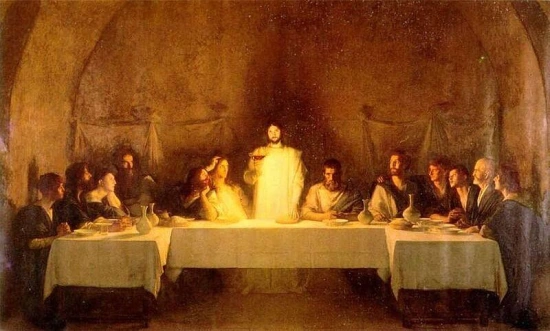
The Last Supper
26. And as they were eating, Jesus taking the bread, and blessing, broke [it], and gave to the disciples, and said, “Take, eat; this is My body.”
27. And taking the cup, and giving thanks, He gave [it] to them saying, “Drink out of it, all of you.”
28. “For this is My blood, the [blood] of the New Covenant, which [is] poured out for many for the remission of sins.
29. And I say to you, that I will not drink henceforth of this produce of the vine, until that day when I drink it new with you in the kingdom of My Father.”
30. And when they had sung a hymn, they went out into the Mount of Olives.
While Judas’ self-incriminating words are still hanging in the air, Jesus takes bread, blesses it, breaks it, and gives it to His disciples. He had already broken bread at the time of the miraculous feeding of the five thousand, and again at the feeding of the four thousand. But this time He adds something new — and most dramatic. After He offers the bread, He says, “Take, eat, this is My body” (Matthew 26:26). Just as “bread” is a general term that represents all food that nourishes our bodies, God’s love — the bread of heaven — nourishes our spirit. 15
Jesus then picks up the cup, gives thanks, and passes it to His disciples, saying, “Drink from it, all of you. For this is the blood of the new covenant, which is shed for many for the remission of sins” (Matthew 26:26-28). Here Jesus is comparing the truth that He has brought to the human race to the function of blood in the human body. Circulating continuously, blood carries oxygen, nutrients, hormones, and heat to every part of the body. It also carries antibodies which help to heal wounds, fight infection, and protect against disease.
By analogy, then, we can begin to appreciate what the Lord’s truth does for our spiritual body. It helps us to identify, fight against, and remove evil thoughts and desires that would otherwise infect and destroy us. This is what Jesus means when He says that His blood has been given “for the remission of sins.” In saying this, Jesus is making it clear that the remission of sins takes place through looking to Him alone as the source of divine truth. 16
The “blood of the lamb,” then — in spiritual terms — must be applied to the doorposts of our mind. This is the truth of the Lord’s Word circulating throughout our spiritual bodies, inspiring us with hope and filling us with vitality while defending us from destructive thoughts and emotions. The children of Israel were told to sacrifice a lamb and place its blood over the doorposts of their homes. That was the blood of the old covenant. But the blood of the new covenant is spiritual truth. It is to be placed on the doorposts of our minds to protect us against evil and inspire us to do good.
In the Holy Supper, Christians re-enact this sacred moment when Jesus offered His disciples bread to eat, saying, “This is My body” and offered them wine to drink, saying, “This is My blood.” In this new covenant we can understand that the literal flesh and blood correspond to the heavenly bread of divine love and the spiritual wine of divine wisdom. When seen in this way, the humble reception of bread and wine during the Holy Supper can represent our willingness to receive the Lord’s goodness and truth — the two qualities that make us truly human. The more we have of these qualities, the more human we become, for they have their origin in God.
Throughout this last supper with His disciples, Jesus is aware that the hour of His crucifixion is near, and that His death is imminent. Nevertheless, as Jesus faces this upcoming trial, He continues to keep His focus on the Passover, which traditionally ends with hymns of praise and thanksgiving. We read, therefore, that “When they had sung a hymn, they went out to the Mount of Olives” (Matthew 26:30). It is a fitting conclusion to the last supper He would have with His disciples while on earth.
A practical application
When Jesus speaks about the bread being His “body” and the wine being His “blood,” He is using physical terms to describe spiritual reality. Nevertheless, the Holy Supper is more than a symbolic act. When done reverently, remembering all that the Lord has done for us, the Holy Supper connects us to the Lord Jesus Christ in His Divine Humanity. As a practical application, then, take the Holy Supper knowing that you are receiving the Lord’s power, through His love and wisdom, to overcome the hells, order your mind, and become a new person. It is for this reason that the Holy Supper is also called Holy Communion — that is, communion with God. 17
The Sheep of the Flock will be Scattered
31. Then says Jesus to them, “All [of] you shall be made to stumble in Me in this night; for it is written,’ I will smite the shepherd, and the sheep of the flock shall be scattered.’
32. But after I am risen, I will go before you into Galilee.”
33. But Peter answering said to Him, “Though all shall be made to stumble in Thee, I will never be made to stumble.”
34. Jesus declared to him, “Amen I say to thee, that in this night, before the cock crows, thou shalt three times deny Me.”
35. Peter says to Him, “Though I must die with Thee, I will not deny Thee.” Likewise said all the disciples.
After finishing the Passover meal and celebration, Jesus and His disciples go up to the Mount of Olives. Jesus already knows that all of His disciples will forsake Him at some point. As He says, “All of you will be made to stumble because of Me.” Then, to confirm His prediction, He quotes these words, written through the prophet Zechariah: “I will strike the Shepherd, and the sheep of the flock will be scattered” (Matthew 26:31).
Nevertheless, Jesus also knows that the story does not end with betrayal or crucifixion. As He says, “But after I have been raised, I will go before you to Galilee” (Matthew 26:32). No matter how agonizing the crucifixion will be, Jesus knows that resurrection will follow. His mind and heart are not focused on the impending suffering, but rather on the great work that is soon to be accomplished.
Similarly, we can know that there will be trials to go through along the path of our spiritual development, with many challenges along the way. But if we keep our focus on the bigger picture, we will be able to enter every spiritual struggle with faith in our hearts. However fierce the battle, we can know that victory is assured because the Lord, who fights for us, is inmostly present. This is pictured by Jesus and His disciples on the Mount of Olives. 18
Even so, there are times when we spiritually “come down” from the mountain. These are the times when we fall away from heightened states of love, times when our high resolve is challenged, and times when we “will be made to stumble.” When we are faced with challenges, we have the opportunity to strengthen our faith. But often, when faced with challenges, we backslide and stumble. And this is what will happen with the disciples.
Jesus has just predicted that all of the disciples will be made to stumble that very night, but Peter refuses to believe this. Instead, he is adamant about his devotion to Jesus. “Even if all are made to stumble,” he says, “I will never be made to stumble.” And then he adds, “Even if I have to die with you, I will not deny you” (Matthew 26:35). And all the rest of the disciples say the same.
Jesus, however, knows otherwise. He knows that Peter will deny Him three times that very night — even before the rooster crows at dawn. He also knows that each of us, like every one of the disciples, will stumble many times in our efforts to grow spiritually, even though we, like Peter, are confident that we will never stumble again. It’s a vital lesson that we all must learn, however painful the process might be.
A practical application
In order to grow spiritually, confidence in self must be replaced by full confidence in the Lord. It’s a hard lesson, learned gradually through relapse and recovery, over and over again. In other words, we will continue to stumble until we finally realize that our only hope, our only trust, and our only confidence is in the Lord. As a practical application, then, learn to take occasional relapses in stride. See it as part of your journey. As it is written in the psalms, “Though they stumble, they shall not be utterly cast down; for the Lord upholds them with His hand” (Psalms 37:24). Also, “It is better to trust in the Lord than to put confidence in man” (Psalms 118:8). 19
In the Garden of Gethsemane
36. Then comes Jesus with them to a place called Gethsemane, and says to the disciples, “Sit ye here, while I going away shall pray [over] there.”
37. And taking Peter and the two sons of Zebedee, He began to sorrow, and to be in agony.
38. Then He says to them, “My soul is surrounded with sorrow unto death; remain ye here, and watch with me.”
39. And coming forward a little, He fell on His face, praying, and saying, “My Father, if it be possible, let this cup pass from Me; nevertheless, not as I will, but as Thou [willest].”
40. And He comes to the disciples, and finds them sleeping, and says to Peter, “Had you thus not strength one hour to watch with Me?
41. Watch and pray that you enter not into temptation; the spirit indeed is eager, but the flesh [is] weak.”
42. Again for a second [time] going away, He prayed, saying, “My Father, if this cup cannot pass away from Me unless I drink it, Thy will be done.”
43. And coming, He finds them sleeping again; for their eyes were heavy.
44. And leaving them, going away again, He prayed for a third [time], saying the same word.
45. Then He comes to His disciples, and says to them, “Do you sleep still, and rest? Behold, the hour is near, and the Son of Man is betrayed into the hands of sinners.
46. Arise, let us lead [the way]; behold, he that betrays Me is near.”
As Jesus and His disciples make the descent from the Mount of Olives, they enter a small garden called “the Garden of Gethsemane.” The geography of descent symbolizes the way we experience ups and downs in our own spiritual life. From high points of firm resolve and unwavering faith we come down into times of doubt, times when our faith is challenged, and when our highest ideals are threatened.
At those times when we are under spiritual attack, we can feel discouraged and disheartened as we suffer the pressure and distress of mental anguish. Fittingly, the Greek word “Gethsemane” [Γεθσημανί] means “oil press.” In biblical times, oil was extracted from olives by using a stone press that crushed the olives. In this way, the precious oil was released. The oil was then used in many important ways. It served as the oil for anointing kings, healing wounds, and lighting lamps. Its golden color, its warm smooth feel, and its ability to provide both heat and light made it an appropriate symbol of God’s love. The crushing of the olive, then, can be seen as an accurate description of the spiritual pressure and mental anguish that Jesus is about to undergo. 20
This powerful episode begins with Jesus saying to His disciples, “Sit here while I go and pray over there” (Matthew 26:36). Then, taking Peter, James, and John with Him, He enters His time of agony. As it is written, “He began to be sorrowful and deeply distressed” (Matthew 26:37). The Gospel of Matthew tells us very little about Jesus’ mental anguish at this point except that He says, “My soul is exceedingly sorrowful, even to death” (Matthew 26:38). These words echo the prophecy given in the Hebrew scriptures. As it is written, “He poured out His soul unto death” (Isaiah 53:12).
Just a short time ago, Jesus was celebrating the Passover with His disciples. But now, as He enters the Garden of Gethsemane at the foot of the Mount of Olives, He experiences profound sorrow — even unto death. Going a little farther ahead, He falls on the ground, prostrates Himself in deepest anguish and says, “O My Father, if it is possible, let this cup pass from Me” (Matthew 26:39).
The agony of our temptations is directly related to the love that is being challenged at the moment. If the bonds of affection are minimal, the grief that is experienced will also be minimal. On the other hand, if the love is deep and profound, the grief will be equally deep and agonizing. Many people are familiar with the overwhelming sense of grief that accompanies the loss of a loved one. The deeper the love, the deeper the anguish. 21
In the Lord’s case, however, it is impossible for us to comprehend the severity of the temptations that He endured. This is because we can never know the full extent of His love. We can know, however, that He fought, not from any self-serving love, but from the profoundest love of all — the love for the salvation of the entire human race. In Jesus, this love was relentlessly challenged by hellish forces that attacked Him at every possible moment and in every possible way from His earliest childhood throughout His life. And now, at Gethsemane, these hellish forces are reaching a new height of severity, commensurate with the divine love that is within Jesus, at His very core. 22
Jesus knows that His hour is near, and that He is soon to drink fully from the cup of utmost suffering. On one level, this “cup” represents the physical circumstance of the crucifixion. He knows that this will involve dreadful physical pain, even to the loss of His physical life. At the level of thought and feeling, however, this cup represents temptations — that is, Jesus’ combats against the hells. The hells are endeavoring with all their might to inject feelings of despair and get Jesus to abandon His mission.
While we cannot know precisely what Jesus is thinking and feeling, we can imagine that the hells, working through Jesus’ merely human heredity, might be suggesting doubts. We can imagine that Jesus might be faced with doubts about the future existence of those He came to save. Was His mission in vain? How could His crucifixion possibly bring about salvation? Couldn’t there be a better, easier, less painful way? How could His death bring about new life? How could His noble mission be advanced if He were to die now after such a short time?
All of these questions, and many more, could have arisen in Jesus’ mind causing doubts about His noble cause and despair about the future of humanity. Therefore, He prays, “O My Father, if it be possible, let this cup pass from Me” (Matthew 26:39).
As many know from their own experience, the agony of temptation is not always lifted in a moment. Each of us must return, again and again, to the power of prayer, each time asking God for His strength and protection. This is why Jesus prays repeatedly that the cup might pass from Him, acknowledging each time that if it cannot pass, that God’s will be done. He repeats the same prayer three times, ending each prayer with a version of the everlasting words, “Not My will, but Thy will be done” (Matthew 26:39, 42, 44).
Watch and pray
When Jesus first entered the Garden of Gethsemane with His disciples, He specifically asked Peter, James, and John to stay with Him and watch with Him (see Matthew 26:38). But instead of being watchful, they fall asleep. Therefore, Jesus says to them, “Could you not watch with Me one hour?” (Matthew 26:40), and again He says, “Watch and pray, lest you enter into temptation” (Matthew 26:41). No matter how often Jesus tells them to be watchful, they keep falling asleep.
It is important to note that Jesus does not just tell them to “watch.” He says, “watch and pray” lest they fall into temptation. In the preceding episode the disciples had symbolically received the love and wisdom of the new covenant as they ate the bread and drank the wine of the Holy Supper. This love and wisdom are given to protect us from the evil desires and false thoughts that attempt to invade our minds and destroy our souls. To protect against this encroachment, we must be ever watchful, alert, and spiritually awake to what is happening in our inner world. Too often, we are like the disciples who keep falling asleep — even though Jesus keeps reminding them to “watch and pray.”
We “watch and pray” when we are aware that without the Lord our spiritual lives are at risk every moment. Similarly, we “watch and pray” when we choose to remain in the Lord’s love, guided by His truth. When Jesus asks His disciples to “stay awake,” He is speaking to us as well. We must be spiritually vigilant. We cannot allow ourselves to be lulled into the complacency of self-reliance, trusting in our own strength rather than relying on God.
There are indeed “grace periods” along the spiritual path, times when we feel content, relaxed, and at peace. But even then, we cannot drop our guard. We must “watch and pray,” lest we be taken by surprise and tempted to respond with a sudden burst of anger, a wave of self-pity, an eruption of pride, or a sarcastic comment. These are our “Gethsemanes.” These are times of crushing pressure when we find ourselves tempted to act from our lower nature while knowing that if we “watch and pray” we can choose to respond from love. 23
Even though Jesus has repeatedly told them to watch and pray, the disciples keep falling asleep. It’s a lesson for each of us. We must stay spiritually awake, always ready to combat evil, fully prepared with love in our hearts, truth in our minds, and a prayer to the Lord on our lips. The more we do this, moving through life aware and alert, we will develop an early warning system — the spiritual ability to detect unpleasant moods, uncharitable thoughts, and unloving feelings at their earliest and most subtle arising.
Like destructive weeds, as they first thrust their tiny shoots above the ground, these moods, thoughts, and feelings can be identified and uprooted. And it gets easier with practice — but we must be ever watchful. For “the betrayer” will always be at hand. Therefore, as this episode comes to a close, Jesus says, “Are you still resting and sleeping? Behold the hour is at hand, and the Son of Man is being betrayed into the hands of sinners” (Matthew 26:45). Therefore, Jesus tells His disciples to “Rise, let us be going” (Matthew 26:46). But it is too late. “See,” says Jesus, “he who betrays Me is at hand” (Matthew 26:46).
A practical application
The admonition to “watch and pray” has been a consistent theme throughout these final chapters. This is especially true when Jesus enters the Garden of Gethsemane with His disciples. He keeps warning them to stay awake, but they keep falling asleep. We, too, fall asleep spiritually whenever we let down our guard, forgetting that our “betrayer” is at hand. In the literal since, the betrayer is Judas. But in the spiritual sense, our “betrayer” is every selfish desire that would lead us away from the Lord’s love, and every false thought that would lead us away from trusting in the Lord’s truth. As a practical application, then, stay awake to spiritual reality. Don’t be lulled asleep by negative influences and false thoughts. Instead, clothe yourself in the mighty garments of divine truth. As it is written in the Hebrew scriptures, “Awake, awake! Clothe yourself with strength…. Put on your beautiful garments” (Isaiah 52:1).
The Capture
47. And while He was yet speaking, behold, Judas, one of the twelve, came, and with him a crowd of many, with swords and wooden [rods], from the chief priests and elders of the people.
48. And he that betrayed Him gave them a sign, saying, “Whomever I shall kiss, is He; take hold of Him.”
49. And straightway coming to Jesus, he said, “Hail, Rabbi.” and kissed Him.
50. And Jesus said to him, “Fellow, why art thou here?” Then coming, they put [their] hands on Jesus, and took hold of Him.
51. And behold, one of them with Jesus, stretching out the hand, withdrew his sword, and smiting the servant of the chief priest, took off his ear.
52. Then says Jesus to him, “Return thy sword into its place, for all they that take the sword shall perish by the sword.
53. Thinkest thou that I cannot now implore my Father, and He will cause to stand by Me more than twelve legions of angels?
54. How then would the Scriptures be fulfilled, that so it ought to be?”
55. In that same hour Jesus said to the crowd, “Are you come out as against a robber with swords and wooden [rods] to take Me? I sat daily with you teaching in the temple, and you did not [take] hold of Me.
56. But all this came to pass, that the Scriptures of the prophets might be fulfilled.” Then all the disciples, leaving Him, fled.
Even as Jesus is reminding His disciples to watch and pray, Judas arrives with “a great multitude” carrying “swords and clubs” (Matthew 26:47). They have been sent by the religious leaders to arrest Jesus and take Him captive. Judas has arranged to give them a sign by which they will know which one is Jesus. Judas has told them, “Whomever I kiss, He is the One; seize Him” (Matthew 26:48).
According to plan, then, Judas meets Jesus, says, “Greetings, Rabbi!” and kisses Him. Normally, a kiss is a sweet and loving gesture of unity and friendship. But Judas’ kiss is just the opposite. It is the kiss of the hypocrite — by no means the kiss of a friend. It is the kiss of one who praises the Lord with his lips, but whose heart is far from Him.
Judas’ kiss is the sign that Jesus is the one to be captured. But as a soldier moves in for the arrest, one of the disciples takes out a sword and cuts off the soldier’s ear. Earlier in His ministry, Jesus said, “I did not come to bring peace, but a sword” (Matthew 10:34). But now Jesus teaches a different lesson: “Put your sword in its place,” He says, “for all who take the sword will perish by the sword” (Matthew 26:52).
A “sword,” it will be recalled, symbolizes the ability of truth to make sharp discernments between right and wrong. Like a sword, truth fights for us. It defends us from evil and falsity, and it protects all that is good and true in us. Such “fighting truth” is vital, for without a knowledge of the truth we would not be able to defend ourselves against falsity or “cut out” those negative thoughts and destructive behaviors that are so detrimental to our spiritual development.
In this case, however, the sword has a different representation. All who believe falsity shall perish by falsity. As Jesus says, “Put your sword in its place, for all who take the sword will perish by the sword (Matthew 26:52). 24
Immediately after Jesus tells the disciple to put down his sword, He says, “Do you think that I cannot now pray to My Father, and He will provide Me with more than twelve legions of angels?” (Matthew 26:53). “Praying to the Father” represents drawing upon the divine love within Him, a love more powerful than anything on earth or in heaven — for it is the divine omnipotence itself. 25
Here we see a continuation of the previous episode in which Jesus entreated His disciples to “watch and pray.” Once again, Jesus speaks of the efficacy of prayer, reminding us that it is more powerful than the sword, for it connects us with the most powerful force in the universe, that is, with God.
All of this, however, is confusing for the disciples. At this point in their spiritual development, they can understand combat and victory in its most external forms. But they are not yet able to understand much about internal combat — and especially the nature of the internal combat that is going on within Jesus. The disciples do not understand that while Jesus is externally surrendering to His captors, internally He is valiantly fighting against the hells. Unable to grasp this deeper reality, and afraid that they will also be taken captive, the disciples forsake Jesus and flee away (see Matthew 26:56). 26
A practical application
After we have spent many years fighting against those who disagree with us, obstinately insisting that our point of view must be accepted, and relentlessly clinging to our position regardless of what others say, it’s difficult to put down the sword of being right. It’s challenging to put aside the need to reflexively defend ourselves. It’s even more difficult to believe that we do not have to fight in order to conquer. We have been “living by the sword” for so long that it has become second nature. As Jesus says, “All those who live by the sword shall die by the sword.” The sword, which is usually a symbol for truth, can also represent falsity. It is especially the kind of falsity that emphasizes truth without goodness, that wants to be right without being kind, and is dismissive of others without considering another point of view. Whenever we do this, stubbornly clinging to our position, our “truth” becomes a falsity. As a practical application, then, practice “putting down the sword.” Resist the urge to win an argument. Instead, put down your sword and strive to understand.
Peter Follows … at a Distance
57. And they that [took] hold of Jesus led [Him] away to Caiaphas the chief priest, where the scribes and the elders were gathered together.
58. But Peter followed Him from afar off up to the courtyard of the chief priest, and entering inside, sat with the attendants, to see the end.
59. And the chief priests, and the elders, and the whole council, sought false witness against Jesus, so that they might put Him to death,
60. And found none; though many false witnesses came, they found none. But at last two false witnesses, coming, said,
61. This [Man] declared, “I am able to undo the temple of God, and within three days to build it.”
62. And the chief priest standing up, said to Him, “Answerest Thou nothing? What do these witness against Thee?”
63. But Jesus was silent. And the chief priest answering said to Him, “I adjure Thee by the living God, that Thou tell us if Thou be the Christ, the Son of God.”
64. Jesus says to him, “Thou hast said; nevertheless I say to you, From henceforth you shall see the Son of Man sitting on the right hand of power, and coming on the clouds of heaven.”
65. Then the chief priest rent his garments, saying, “He has blasphemed; what further need have we of witnesses? See, now you have heard His blasphemy.
66 What do you think?” They answered and said, “He is subject to death.”
67 Then did they spit in His face, and buffeted Him; and they hit [Him],
68 saying, “Prophesy unto us, Christ. Who is he that smote Thee?”
It is written that “all of the disciples forsook Him and fled.” And yet, it is also written that Peter followed Him at a distance” (Matthew 26:58). This is because Peter represents our faith — a faith that still hangs on, hoping for the best. But it is a wavering faith. While it still follows Jesus, it follows Him “at a distance.” And it watches as they lead Jesus away and take Him to Caiaphas, the high priest. There the religious leaders secretly conspire, ready to accuse Jesus of blasphemy so that He might be put to death.
During this time, many false witnesses testify against Jesus, but nothing of substance is said. Finally, two of the false witnesses step forward and say, “This fellow said, ‘I am able to destroy the temple of God and to build it in three days’” (Matthew 26:61). Two chapters earlier, when Jesus spoke about the temple, He said, “Not one stone shall be left upon another that shall not be thrown down” (Matthew 24:2), but He never said that He would destroy the temple. Therefore, what He is accused of is a complete misrepresentation of Jesus’ words. As it is written in the Psalms of David, “All day they twist my words. All their thoughts are against me for evil…. They conspire. They lurk. They watch my steps, hoping to take my life” (Psalms 56:5-6). 27
Nevertheless, this false accusation contains a deep truth. Jesus’ body is indeed a temple housing the living spirit of God. It is a temple that will be beaten, whipped, crucified, and indeed “destroyed,” but not before Jesus has finished His work on earth. And He will indeed “build it in three days.” That is, He will rise again, no longer in the earthly body that He took on from Mary. That “temple” will be destroyed. But it will rise again in the form of a risen and glorified Humanity — a new and Holy Temple, purified of all human weakness, and filled with all divine power.
When Jesus refuses to defend Himself, the high priest stands up and says, “Are You not going to answer? What are these men testifying against You?” (Matthew 26:62). Frustrated by Jesus’ silence, the high priest says, “By the living God, I place You under oath. Tell us whether or not You are the Christ, the Son of God” (Matthew 26:63). In response, Jesus simply says, “You say” (Matthew 26:64). Jesus then adds these words, “Hereafter you will see the Son of Man, sitting at the right hand of Power, and coming in the clouds of heaven” (Matthew 26:64).
For Jesus, this is another reference to the divine love (the “right hand of Power”) which comes through divine truth (“the clouds of heaven”). This response is a repetition of the promise Jesus made two chapters earlier when He said, “They will see the Son of Man coming in the clouds of heaven with power and great glory” (Matthew 24:30). This time, Jesus adds the phrase, “the right hand of Power.” This refers to the omnipotence of God when divine love is working through the literal truths of the Word. 28
For the literal-minded high priest, however, Jesus’ response is blasphemy. Infuriated by the idea that Jesus has somehow equated Himself with God, the high priest tears his clothes and cries out, “He has spoken blasphemy! What further need do we have for witnesses? Look, now you have heard His blasphemy!” (Matthew 26:65). Agreeing with this conclusion, those who are present cry out, “He is deserving of death” (Matthew 26:66). Then they spit in His face, and beat Him, saying, “Prophesy to us, Christ! Who is the one who struck You?” (Matthew 26:68).
A practical application
If you have ever been accused of something that you did not do, you know what it means to be the innocent victim of false witness. This is especially the case when Jesus is falsely accused of intending to destroy the temple. While it is true that Jesus told His disciples that “not one stone shall be left here upon another that shall not be thrown down” (Matthew 24:2), He never said that He would destroy the temple. He was, in fact, referring to His own body that would be crucified. Just as Jesus’ words were misunderstood and twisted so as to provide false evidence against Him, the hells can cloud our understanding. As a result, we can misunderstand and misinterpret what others say and do, attributing evil motives when nothing evil is meant, and ascribing malicious intent when nothing malicious is intended, so much so that we can begin to see good as evil and evil as good. As a practical application, then, consider how easy it is to misunderstand what others say and do. As an antidote, learn to say, “What did you mean by that?” and “What was your intention?” This can help you to rise above the negative messages and distortions of truth that flow in from hell. Instead, strive to put the best interpretation on the outward actions of others. As it is written in the Hebrew scriptures, “Man looks at the outward appearance, but the Lord looks at the heart (1 Samuel 16:7). 29
The Crowing of the Rooster
69. And Peter sat outside in the courtyard; and one maid came unto him, saying, “Thou also wast with Jesus of Galilee.”
70 But he denied before [them] all, saying, “I know not what thou sayest.”
71 And when he was gone out into the porch, another [maid] saw him, and said unto those that were there, “This [man] was also with Jesus of Nazareth.””
72 And again he denied with an oath, “I do not know the Man.”
73 And after a while came unto [him] they that stood by, and said to Peter, “Truly thou also art [one] of them; for thy speech betrays thee.”
74 Then he began to curse and to swear, [saying], “I know not the Man.” And straightway the cock crowed.
75 And Peter remembered the saying of Jesus, which He said unto him, “Before the cock crows, thou shalt deny Me three times.” And going outside, he wept bitterly.
While Jesus is being reviled and spat upon by the religious leaders in Caiaphas’ palace, Peter remains outside in the courtyard. Wavering faith will not come to the rescue. This is the kind of faith which is in our mouth, and maybe also in our understanding, but not yet in our hearts.
Although Peter has been adamant that He will never deny Jesus (see Matthew 26:34), he now proceeds to deny Him, not just once, but three times. We read, “And a servant girl came to Peter, saying, ‘You also were with Jesus of Galilee.’ But he denied it” (Matthew 26:69). This is the first denial. Again, another girl comes and says, “This fellow also was with Jesus of Nazareth” (Matthew 26:71). Once again, Peter denies that he knows Jesus. This is the second denial, and this time he is even more adamant. Peter makes an oath, saying, “I do not know the Man” (Matthew 26:72).
Each of these servant girls represents a gentle stirring of affections, an inclination to follow the Lord, and live by the truth that He teaches. But, like Peter, we hesitate. We may think, “Will it be uncomfortable?” “Will I be embarrassed?” “Will I lose friends?” “Will I have to suffer for my faith?” Like Peter, we still follow the Lord — but from a distance. The gentle stirring of our hearts is not strong enough to overcome our fears and doubts.
Finally, Peter is given a third opportunity to assert his allegiance to Jesus. Others come to him and say, “Surely you are one of them because your speech betrays you” (Matthew 26:73). This time Peter’s denial is even more vehement than before. In the first instance, Peter simply denies knowing Jesus. The second time, Peter’s denial is accompanied by an oath. But this third time he passionately denies any acquaintance with Jesus. As it written, Peter “began to curse and swear, saying, ‘I do not know the Man’” (Matthew 26:74).
Peter’s response must give us pause. We need to ask ourselves, “Whatever happened to the faithful disciple who said, ‘Even if all are made to stumble because of You, I will never be made to stumble’”? (Matthew 26:33).
The answer is that Peter needs to learn a lesson that we all must learn. Our faith will be tried. It’s part of the journey. Our job is to be ready and watchful when those trials come, confessing our faith in God by living according to His Word. This is the very lesson that Peter needs to learn. It is a lesson that is brought home to him with heart-breaking poignancy when the rooster crows. As Jesus said to Peter when He prophesied this moment in Peter’s life, “Before the rooster crows, you will deny Me three times” (Matthew 26:75).
The crowing of the rooster at the break of dawn is a dark moment for Peter. We read that “he went out and wept bitterly” (Matthew 26:75). Yet, that same crowing has another meaning too. For the crowing of the rooster also marks the end of our darkest hour, and the beginning of a new day. After every night there comes the dawn. And so, in the crowing of the rooster, Jesus not only prophesies Peter’s betrayal, but also the dawning of a new awareness — not just for Peter, but for all humanity.
A practical application
When Peter heard the crowing of the rooster, his heart sank and he wept bitterly. Even though he swore that He would never betray or abandon Jesus, he did. We, too, can experience times when we fail to live up to the high expectations we have for ourselves. We may resolve like saints, believing that we will never waiver or stumble, but we do waiver and we do stumble — just as Jesus predicted. Nevertheless, every stumble can be a stepping-stone to a new beginning. The key is to admit that we have stumbled, and not make excuses. We can, like Peter, feel genuine remorse. Then we can get up and get going, humbler but wiser. As a practical application, then, allow yourself to feel genuine remorse for failing to follow the Lord’s teachings. At the same time, you can view this experience as an opportunity to grow spiritually, knowing that at some point you will have another chance to respond differently. Therefore, when the rooster crows, it need not be a sign of defeat. It can also be a reminder that a new day is about to dawn. As it is written in the Hebrew scriptures, “The steadfast love of the Lord never ceases…. His mercies are new every morning” (Lamentations 3:23). 30
Footnotes:
1. Arcana Coelestia 8873: “Life from the Lord flows solely into a humble and submissive heart, because such a heart has been fitted to receive. That such is the case is because when the heart is truly humble, nothing of the love of self and of the love of the world stands in the way.” See also Arcana Coelestia 8271: “Divine worship consists in the exaltation of the Lord relatively to oneself…. When people are in this essential, they are in a state of receiving from the Lord the truth which is of faith and the good which is of charity, consequently in a state of worshiping Him. But if people exalt themselves before the Lord, they close the interiors of their mind for the reception of good and truth from the Lord.”
2. True Christian Religion 498:2: “A person is prey to two loves, that of dominating others and that of possessing everyone’s wealth. These loves, if given free rein, race away without limit. The hereditary evils that people acquire by birth come chiefly from those two loves…. Those who are controlled by these loves see themselves as the single person in whom and for whom all others exist. Because they are without compassion, fear of God, or love for the neighbor, they are unmerciful, savage, and cruel. Their greed and their longing to rob and steal are hellish, and they are sly and deceitful in carrying out such crimes.”
3. Arcana Coelestia 6475: “All in hell think against the Lord, nor do they attribute anything to Him which is above what is human; and yet most say that they acknowledge a Supreme Being, by which they mean the Father, and nevertheless live in hatred and revenge, and continually desire to be exalted over others, and to be worshiped as gods, and in this way they make hell for themselves. It is very different with those who acknowledge the Lord, and believe in Him from the heart. From this also it is evident that the Lord flows into all, both generally through heaven, and singularly, and also universally from Himself; and that where the good of charity is, there He is; and also where the contrary is, there also He is, but in no other way than to give them life, and to withdraw them from evil insofar as this can be done.” See also Apocalypse Explained 899:8: “Resurrection to life takes place by reformation and regeneration, and these are effected by the removal and separation of evils, which condemn people, and which constitute spiritual death.”
4. Arcana Coelestia 1692: “It is the Lord alone who fights in those who are in the combats of temptation, and who overcomes. From themselves people have no power at all against evil or infernal spirits.” See also Arcana Coelestia 2273:2: “The temptations in which people overcome are attended with the belief that … they are infernal rather than heavenly…. If they come into thoughts contrary to these, they [must go through] … similar temptations and sometimes more grievous ones, until they have been reduced to such sanity that they believe they merit nothing.”
5. Divine Providence 329: “The Lord continually flows into the will with a power that enables people to shun evils, and into the intellect with a power that enables people to think that there is a God.” See also Heaven and Hell 371: “Truth is the only vessel for the [inflowing] good. It follows that nothing can be received from the Lord and from heaven by anyone who is not in truths. Therefore, to the extent that the truths with people are conjoined to good, people are conjoined to the Lord and to heaven.” See also Arcana Coelestia 9039:3: “The Lord flows with power into those who are humble; but not into those who are puffed up, because the former receive influx, but the latter reject it.”
6. Arcana Coelestia 2273:1-2: “People are not saved because of temptations if they take any credit for them. If they do, it is the result of conceit. They boast about it, consider themselves more deserving of heaven than others, and contemplate their superiority over others, despising others in comparison with themselves. All these impulses are contrary to the mutual love and blessings of heaven. When there is true victory in temptation, the belief arises that all others are more deserving than oneself, and that one is infernal rather than heavenly…. If thoughts contrary to these arise, it is an indication that they have not overcome…. Therefore, they will again come into similar temptations, and sometimes into more grievous ones, until they have been reduced to such sanity that they believe they deserve nothing.”
7. Arcana Coelestia 32: “Love pervades the whole of heaven, for in the heavens no other life is found except the life that belongs to love. This is the source of all happiness in heaven, a happiness so great that no aspect of it can be described or in any way captured in human concepts. People in whom this love is present love the Lord wholeheartedly. Yet they realize, say, and perceive that all love, thus all life, which belongs exclusively to love, and so all happiness, come from the Lord and nowhere else, and that they derive not one trace of love, life, and happiness from themselves.” See also Arcana Coelestia 10291: “The spices from which the oil of anointing was prepared signify perceptions and affections of truth and good.” See also Arcana Coelestia 10292: “A fragrant odor signifies the perceptivity of what is grateful.”
8. Arcana Coelestia 4145: “People who are being regenerated believe at first that the good which they think and do is from themselves, and that they also merit something; for they do not yet know, and if they know, they do not comprehend, that good can flow in from some other source, nor that it can be otherwise than that they should be recompensed, because they do it from themselves. Unless they at first believed this, they would never do any good. But by this means they are initiated not only into the affection of doing what is good, but also into knowledge concerning good, and also concerning merit. When in this manner they have been led into the affection of doing what is good, they then begin to think differently and to believe differently, namely, that good flows in from the Lord, and that by the good which they do from their own, they merit nothing. At last, when they are in the affection of willing and doing what is good, they altogether reject self-merit, and even have an aversion for it, and are affected with good from good. When they are in this state, good flows in directly.”
9. Arcana Coelestia 2276:2-3: “The number ‘thirty’ wherever one reads it in the Word, means something relatively small…. Or, how small a value those people placed on the Lord’s merit, and on redemption and salvation from Him. This explains the reference to the thirty pieces of silver in Matthew…. A slave, who was not considered to be worth much, was valued at thirty shekels, as is clear in Moses, ‘If the ox gores a slave or a servant-girl, the owner shall give to his master thirty shekels of silver; and the ox shall be stoned’” (Exodus 21:32).
10. Apocalypse Explained 401:29: “In Egypt they were in a servile state, and thus in a state of ignorance … signified by ‘the setting of the sun.’” See also, Apocalypse Explained 911:18: “Passover signified deliverance from the falsities of evil, which is the first thing of regeneration.”
11. Arcana Coelestia 9410:6: “They who understand only the external sense of the Word and not the internal sense … understand these words of prophecy [‘the blood of the lamb’] no other way than according to the letter. This to say, they take ‘blood’ to mean blood, thus the Lord’s passion, even though the ‘blood’ that proceeds from the Lord signifies divine truth. They who understand true doctrine know that they are not saved by blood, but by hearing divine truth and doing it…. Even so, uneducated people may hold on to the teaching that they are saved by the Lord’s blood, so long as they are leading a life in keeping with His divine truth. This is because those who lead such a life will receive enlightenment in the next life.”
12. Apocalypse Explained 431:6: “In the spiritual sense, ‘the twelve apostles’ signify all truths from good.” See also Arcana Coelestia 433: “The Lord’s twelve disciples represented the church of the Lord in general, and each one of them some universal essential of it.”
13. Arcana Coelestia 402: “Whenever the name of any city occurs in the Word, it never signifies a city but something doctrinal.” See also Arcana Coelestia 2268: “In the Word, the human mind is compared to a ‘city.’” See also Arcana Coelestia 3066: “When the inhabitants of a city are referred to as ‘men,’ it signifies truths.”
14. True Christian Religion 163: “A right idea of God in the church is like the sanctuary and altar in a temple, or like the crown upon the head and the scepter in the hand of a king on his throne; for on a right idea of God the whole body of theology hangs, like a chain on its first link; and if you will believe it, everyone is allotted his place in the heavens in accordance with his idea of God. For that idea is like a touchstone by which the gold and silver are tested, that is, the quality of good and truth in a person.” True Christian Religion 350: “The Lord’s Word is an ocean of truth, vast and deep, from which all angelic wisdom comes. And yet, to those who do not know about its spiritual and heavenly meaning, the Word appears to hold no more than a jug of water.”
15. Heaven and Hell 111: “The term ‘bread,’ in a general sense, corresponds to the affection of all good because it is the food that beyond other food sustains life, and that by ‘bread’ is meant all food. Indeed, it is on account of this correspondence that the Lord calls Himself the ‘Bread of Life.’” See also Arcana Coelestia 4211: “Since ‘bread’ in the highest sense means the Lord, it therefore means everything holy which comes from Him, that is, it means everything good and true. And since no other good exists which is good except the good of love and charity, ‘bread’ therefore means love and charity. Sacrifices in former times had no other meaning, and for that reason were referred to by the single word ‘bread.’ And some of the flesh of the sacrifices was eaten so that the heavenly feast — that is, a joining together through good flowing from love and charity — might be represented. The same is meant today by the Holy Supper, for this has replaced sacrifices and feasts of consecrated things. The Holy Supper is in the church an external practice that has an internal reality within it, and by means of this reality it joins one who is governed by love and charity to heaven, and by means of heaven to the Lord.”
16. Divine Providence 122: “When people wish to repent, they must look to the Lord alone. If they look to God the Father only, they cannot be cleansed; nor if they look to the Father for the sake of the Son, nor if they look to the Son as merely a man. For there is one God, and that one is the Lord, His Divine and Human being one person. In order that people in repenting might look to the Lord alone, Jesus instituted the Holy Supper, which confirms the remission of sins in those who repent. It confirms this because in that Supper or Communion everyone is kept looking to the Lord alone.”
17. True Christian Religion 530: “The question therefore is, ‘How ought a person to repent?’ And the reply is, ‘Actually.’ That is to say, we must examine ourselves, recognize and acknowledge our sins, pray to the Lord, and begin a new life…. Repentance becomes effective if we practice it regularly, that is, every time we prepare ourselves to take the Communion of the Holy Supper. Afterward, if we abstain from one sin or another that we have discovered in ourselves, this is enough to make our repentance real. When we reach this point, we are on the pathway to heaven, because we then begin to turn from being a merely natural person into being a spiritual person and to be born anew under the Lord’s guidance.” See also True Christian Religion 115: “Redemption consisted in the subjugation of the hells, the ordering of the heavens, and the establishment of a new church, because without them no one could have been saved.”
18. Arcana Coelestia 9780:12: “That the Lord so often went up the Mount of Olives was because ‘oil’ and ‘the olive’ signified the good of love, as also does a ‘mountain.’ The reason was that while the Lord was in the world all things respecting Him were representative of heaven; for thereby the universal heaven was adjoined to Him. Therefore, whatever He did and whatever He said was divine and heavenly, and the ultimate things were representative. The Mount of Olives represented heaven in respect to the good of love and of charity.”
19. Arcana Coelestia 8478:5: “Those who are in the stream of providence put their trust in the Divine and attribute all things to Him; but that those who are not in the stream of providence trust in themselves alone and attribute all things to themselves.”
20. Arcana Coelestia 886: “The ‘olive’ signifies the good of charity. This is evident from the signification in the Word not only of an ‘olive’ but also of ‘oil.’ It was with olive oil, together with spices, that the priests and kings were anointed, and it was with olive oil that the lamps were trimmed…. The reason olive oil was used for anointing and for lamps was that it represented all that is celestial, and therefore all the good of love and of charity; for the oil is the very essence of the tree, and is as it were its soul, just as the celestial, or the good of love and of charity, is the very essence or the very soul of faith; and hence oil has this representation.”
21. Arcana Coelestia 1690:3: “All temptation is an assault upon the love in which the person is, and the temptation is in the same degree as is the love…. The Lord’s life was love toward the whole human race, and was indeed so great, and of such a quality, as to be nothing but pure love. Against this His life, continual temptations were admitted from His earliest childhood to His last hour in the world.”
22. Arcana Coelestia 1812: “While He lived in the world the Lord was in continual combats of temptations, and in continual victories, from a constant inmost confidence and faith that because He was fighting for the salvation of the whole human race from pure love, He could not but conquer…. In all His combats of temptation the Lord never fought from the love of self, or for Himself, but for all in the universe.”
23. Divine Providence 183: “People from their hereditary evil are always panting for the lowest hell; but the Lord by His providence is continually leading them away and withdrawing them from it, first to a milder hell, then away from hell, and finally to Himself in heaven. This operation of the divine providence is perpetual.” See also Arcana Coelestia 2338: “Temptations involve feelings of doubt regarding the Lord’s presence and mercy, and also regarding His salvation. The evil spirits who are present at such times and who are the cause of temptation do all they can to infuse a negative outlook, but good spirits and angels from the Lord in every way disperse that doubting attitude, all the time preserving a feeling of hope and in the end strengthening an affirmative outlook. Consequently, a person undergoing temptation is stuck between [haeret inter] a negative outlook and an affirmative outlook. Those who give way in temptation remain in a state of doubt, and sink into a negative frame of mind, whereas those who overcome still experience feelings of doubt; yet they allow themselves to be filled with hope, remaining steadfastly in an affirmative outlook…. During such conflict those [who remain affirmative] seem to press the Lord, especially through prayers, to be at hand, to have mercy, to bring help, and to free from condemnation.”
24. Apocalypse Explained 131: “The Lord’s words, ‘Those who take the sword shall perish by the sword’ signify that those who believe falsities will perish by falsities.” See also Apocalypse Explained 412:12: “Truths without good are truths falsified, which in themselves are falsities.”
25. Apocalypse Explained 430:16: “‘Do you think that I cannot now beseech My Father and He will cause to stand by Me more than twelve legions of angels?’ ‘Twelve legions of angels’ meaning the whole heaven, and ‘more than these’ signifying divine omnipotence.” See also Arcana Coelestia 1735: “The Lord’s Internal is Love itself, to which no other attributes are appropriate than those of pure love and so of pure mercy towards the whole human race. Such mercy wills to save all, to make them eternally happy, and to impart to them all that is its Own — thus out of pure mercy and by the mighty power of Love.”
26. Arcana Coelestia 1950:2: “Rational goodness never fights, no matter how much it is assailed, because it is gentle and mild, long-suffering and yielding, for its nature is that of love and mercy. But although it does not fight, it nevertheless conquers all. It does not ever think of combat, nor does it glory in victory. It is of this nature because it is divine and is of itself immune from harm; for no evil can assail good, indeed it cannot even remain in the sphere where good is. Just as soon as it approaches, evil retreats of itself and falls back; for evil is of hell, while good is of heaven.”
27. True Christian Religion 492: “Several times I have heard words issuing forth from heaven about the good actions that come from goodwill. These words passed through the world of spirits and penetrated into hell, even to its greatest depth. Step by step the words turned into words that are directly opposed to the good actions that come from goodwill, and finally became expressions of hatred against the neighbor. This is an indication that everything that emanates from the Lord is good. It is the spirits in hell who turn that emanation into evil. A similar thing happened with some truths related to faith. As they went along, they were turned into falsities opposed to those truths. The receiving form turns what is flowing in into something that harmonizes with itself.”
28. Arcana Coelestia 8281:6: “Throughout the Word, the Lord is called not only the ‘right hand’ and ‘arm’ of Jehovah, but also the ‘strength by which He breaks in pieces His enemies,’ and likewise, the ‘hammer’ as in Jeremiah 51:20, 21 and following. Moreover, the Lord came into the world, and there became divine truth, and afterward divine good from which flows divine truth. He did this so that He might shut up all evils and falsities in the hells, and gather together all forms of goodness and truth into heaven, and there arrange them into divine order. From all this it is now evident that by the ‘right hand of Jehovah’ in the Word is signified the omnipotence which the Divine has by means of divine truth…. In heaven, those who correspond to the shoulders, arms, and hands are they who are powerful from the truth which springs from good; that is, their power is from the faith that springs from love.” See also Apocalypse Explained 63[7]: “The Son of Man is the Lord in respect to His divine humanity, and in respect to the divine truth that proceeds from Him. The phrase, ‘to sit at the right hand of power,’ means that the Lord has omnipotence. The Lord saying that ‘they were now about to see this’ means that divine truth would be in its omnipotence when the Lord conquered the hells and reduced to order all things there and in the heavens, thus, that all those who received Him in faith and love could be saved. To ‘sit at the right hand,’ then, means omnipotence.”
29. Apocalypse Explained 1083:7: “When the eighth commandment, ‘Thou shalt not bear false witness,’ is read, a person by ‘false witness’ understands lying and defamation. But an angel of the spiritual kingdom by ‘false witness’ understands asserting, confirming, and persuading that falsity is truth and evil is good, or on the other hand that truth is falsity and good is evil, while an angel of the celestial kingdom by ‘false witness’ understands every falsity against the Lord, and against heaven in favor of hell.” See also Arcana Coelestia 1088:2: “People with whom no charity is present think nothing else than evil of the neighbor and speak nothing but evil. If they say anything good, it is for the sake of themselves or of one with whom they seek to curry favor under an outward show of friendship. But people in whom charity is present think nothing else than good of the neighbor and speak nothing but good, and this not for their own sake or that of those with whom they seek to curry favor, but from the Lord thus at work within charity. The former are like evil spirits, the latter like angels, residing with someone. Evil spirits never do anything else than stir up a person's evils and falsities and condemn him. Angels, however, stir up nothing but goods and truths; and things that are evil and false they excuse. From these considerations, it is clear that with those in whom no charity is present, evil spirits have dominion, through whom people communicate with hell; and with those in whom charity is present angels have dominion, through whom people communicate with heaven.”
30. Arcana Coelestia 894: “No definite period of time ever exists when anyone is regenerate enough to be able to say, ‘Now I am perfect.’ In fact an unlimited number of states of evil and falsity exist with everyone, not only simple states but also varied and complex ones which, as has been stated, have to be disposed of in such a way that they do not recur. In some states people can be called fairly perfect, but in countless others they cannot. People who have been regenerated during their lifetime, and in whose lives faith in the Lord and charity towards the neighbor have been present, are in the next life being perfected all the time.” See also Arcana Coelestia 2405:8: “Morning signifies the dawn of a new religion…. This dawn occurs both in general, in particular, and even in specific detail. It occurs in general when a religion is being revived on earth. It occurs in particular when an individual is reborn and becomes a new person. In such people, the Lord’s kingdom then dawns.”

